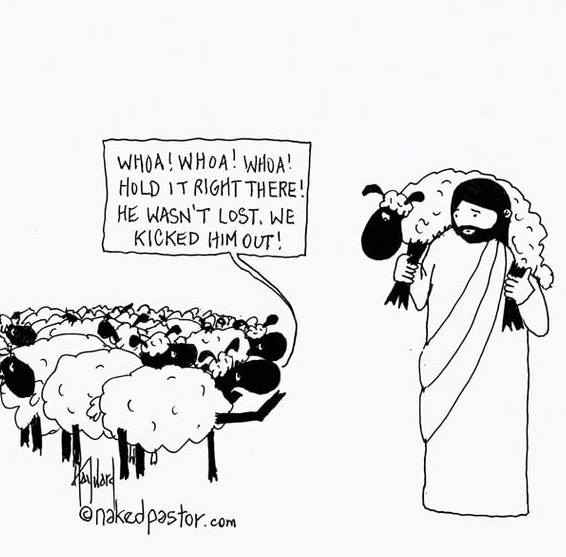
Sunday church bulletin notice: Our good pastor is gone today looking for the sheep we kicked out of the fold during this past year as the last step of our Matthew 18 conflict resolution policy.
While conflicts are hardly ever fun, imagine how “not” fun it would be to find yourself the subject of a “Matthew 18 process” instituted by someone who strongly adheres to law. Although a legalist would certainly make the Matthew 18 process more difficult than if it were led by a person of mercy, the problem lies with the process rather than with the people involved.
In this writing I will share my view that this widely accepted process is flawed and dangerous when used as a tool for Christian conflict resolution because it’s very foundation is formulaic and legalistic.
So how did I acquire such contrary thoughts about the widely accepted process? What prompted me to look deeper into the meaning of Matthew 18?
I was involved with a ministry group for nearly a decade when the leader, who believes and teaches that Matthew 18 is Jesus’ model for conflict-resolution in the Church, made certain accusations against our group as a whole and also against some individual members. Our group denied any wrong-doing and tried to re-negotiation the terms of our relationship with this leader.
What followed was a series of phone calls and emails from the leader attempting to bring us into compliance with his demands. Through much soul-searching, prayer and discernment we decided to stand our ground and continued to press in for a mutual relationship re-negotiation.
In return, the leader instructed that we have no further contact with him.
All the years of walking closely together in the same direction ended because the leader decided that our dismissal was the appropriate step to end the conflict.
Clearly, this was not the outcome that should be expected from Christians involved in conflict. However, the common interpretation of the final step of the reconciliation process, which many in the Body of Christ believe Jesus instituted as the model His church should follow, is to remove (or excommunicate) the offender.
And lest one thinks that this critical view is totally drawn from this lone experience, I’m hear to tell you I have been a part of, or privy to, two other attempts to use Matthew 18 for resolving conflict. In both cases there were no good results and in one of the cases it was disastrous. In fact, in all my many years of life as a Christian, living in two countries and being in association with virtually every part of the Body of Christ, I haven’t encountered anyone who can testify to the process actually resolving conflict.
Now, obviously, I haven’t heard about every Matthew 18 situation but the lack of readily available evidence to dispute my own experience makes questioning the accepted interpretation and application of this as a credible conflict resolution model appropriate.
So, allow me to ask a few questions about Matthew 18 that are weighing heavy on my mind.
Was Jesus really telling His audience, the very ones He was leading into greater truth, that they should still apply the old law in their treatment of each other? Was Jesus reaffirming, with just a slight variation, Deuteronomy 19:15 (concerned with convicting a person of a crime or wrongdoing) as the best way to resolve serious relationship conflicts?
Or was Jesus simply revealing to them what was in their minds and hearts? Was He taking them to the brink of what they would be willing to do to resolve their differences?
Don’t the verses that comprise the “Matthew 18 resolution conflict model” come into direct contrast to what Jesus says about forgiveness in all the other verses of the same chapter? Wasn’t Jesus’ response to Peter’s question about how often he should forgive others pointing his listeners to something far beyond the letter of the law? “Lord, if another member of the church sins against me, how often should I forgive? As many as seven times?” Jesus said to him, “Not seven times, but, I tell you, seventy-seven times.” (Matthew 18 21-22).
Did Paul teach a legalistic approach to conflict resolution among followers of Jesus Christ? Wasn’t Paul’s message completely based on living with each other “with all humility and gentleness, with patience, bearing with one another in love, making every effort to maintain the unity of the Spirit in the bond of peace?” (Ephesians 2-3)
And didn’t Paul speak in direct deference to Matthew 18 in Colossians 3:12-13? “As God’s chosen ones, holy and beloved, clothe yourselves with compassion, kindness, humility, meekness, and patience. Bear with one another and, if anyone has a complaint against another, forgive each other; just as the Lord has forgiven you, so you also must forgive.”
Now get ready because I am going to ask the quintessential question that turns the popular interpretation of Matthew 18 on it’s ear.
Did Jesus take us through a Matthew 18 process in order for us to receive forgiveness for our transgression against God or did He simply lay His life down for us?
Knowing the ultimate of what Jesus did for us, without anything being required of us (Romans 5:8), I have to believe that we’ve missed something important about what He was saying and meaning in Matthew 18.
I have to believe that Jesus wants us to always forgive, always bear with one another, and always choose unity over division.
So who’s with me? Let’s go out together to look for all those “lost sheep” and return them to the fold with no conditions.
And, as far at Matthew 18 goes, let’s continue to seek wisdom from the Holy Spirit and not accept any interpretation until it absolutely lines up with the character and nature of our God who loves and forgives unconditionally.
(Note: Cartoon is courtesy of David Hayward, (nakedpastor.com). David holds a Master of Theology and a Diploma in Ministry and has over 30 years professional pastoral experience. He lives in New Brunswick, Canada.)

 Catholic Apostolic Group