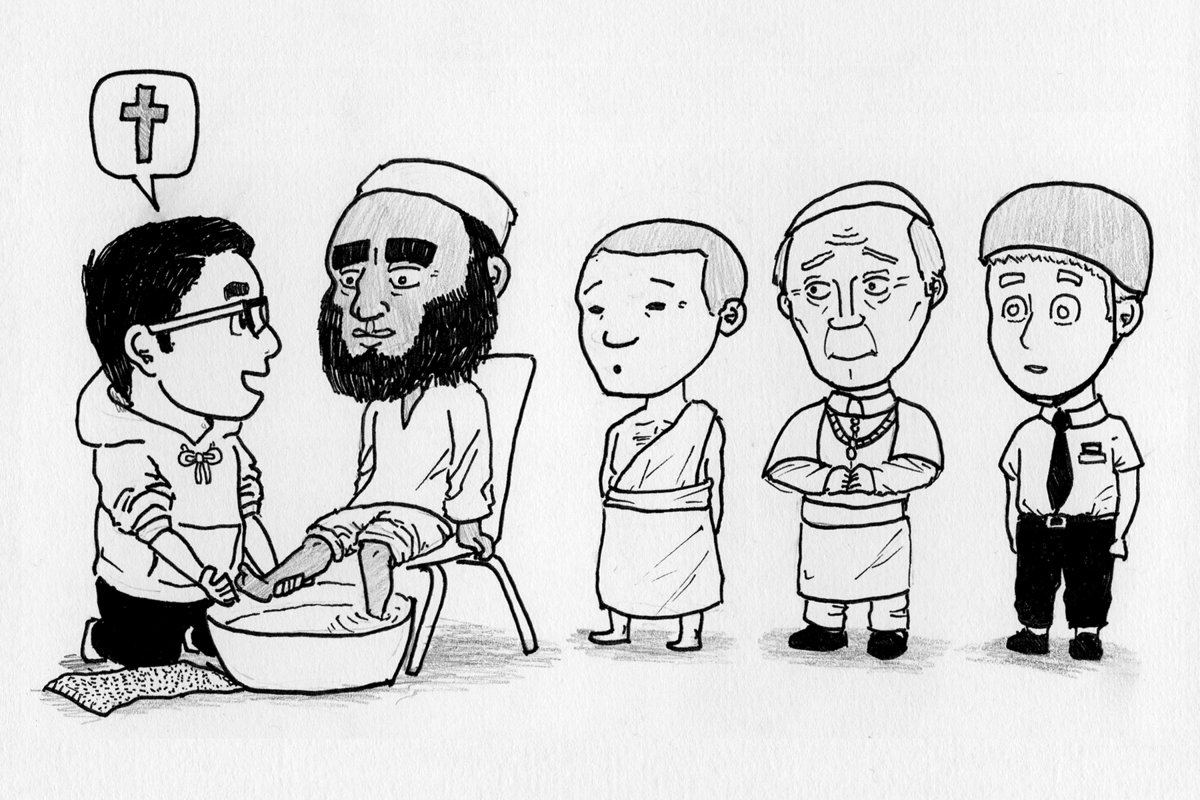
Love your neighbor

Love your neighbor, no exceptions - The Chimes

Illustration by David Rhee/Chime

A child dies at home.

The police are called about a child not breathing and rush to the residence. The exterior of the home looks much like others in the suburban-like neighborhood where homes are close. From the outside view, there is little evidence that all is not well with this family.

That all changed when the police open the front door to expose rooms full of garbage and mold and find an six-month-old child dead inside. The medical examiner’s report attributes the death of the youngest member of the nine-child family to the conditions within the home.

Neighbors gathered in the street are interviewed by local news media. They say that they called the police about suspected problems with the family several times. One neighbor says she “knew” no one would do anything until one of the children “passes away.”

Strangely and tragically, that’s exactly what happened.

What seems to be in play here is what is called a self-fulfilling prophesy, which is an expectation that brings about its own fulfillment. If you believe something to be true, you’ll act as if it were true.

A self-fulfilling prophesy can influence behavior (positive or negative) in a way that ushers the belief into reality. Essentially, it can shape action that leads to those expectations being realized. 

Expecting something to go wrong, you might fail to take steps that could turn things around.

“These expectations can play a part in stereotypes, racism, and discrimination,” according to Kendra Cherry, a psychosocial rehabilitation specialist and psychology educator. “Expecting the worst brings out the worst.”

Whether or not the real-life psychological effect of self-fulfilling prophecy was a factor in the death of this child is conjecture, since the truth will only be revealed as much as those involved are interested in revealing it. One thing is for sure, however: The people who knew or suspected that this child was in danger and failed to take action (other than making calls to authorities), will feel the weight of their inactivity for a long time and maybe for the rest of their lives, as would any of us, under similar circumstances.

So many questions. Did any neighbor go inside the house and see the severe unhealthy conditions? Did any neighbor offer to help if they knew the dangers inside? Was assistance offered but rejected by the adults living in the house? Did any neighbors befriend the family?

This incident – involving actual neighbors – brings much clarity to Jesus’ words written in Matthew 22:36-37. “And one of them, a lawyer, asked him a question to test him. “Teacher, which commandment in the law is the greatest?” He said to him, “‘You shall love the Lord your God with all your heart, and with all your soul, and with all your mind.’ This is the greatest and first commandment. And a second is like it: ‘You shall love your neighbor as yourself.’ On these two commandments hang all the law and the prophets.”

A commandment to love? This doesn’t seem like something you can or should command. How can you make or require someone to love; whether God, another human or, really, anything?

But this is Jesus (Emmanuel – God with us) saying this, so it has to be right and true. Understanding comes by looking at the original language used in Matthew, which is Greek.

The word “love” at the center of this Bible passage is a translation of the Greek word “agape.” Knowing this, it is easier to understand why Jesus would issue a command to us to “love” God and each other. This is because the Greek word agape doesn’t describe a feeling, especially a mushy feeling.

Rather, it describes a God-created force that is felt in some way or form by every entity in the universe from atoms up to entire societies, according to biblical scholar Arie Uittenbogaard, an Abarim Publications writer. So, Matthew was not as much commanding us to generate a personal feeling for God, ourselves, and others but highlighting the concept that we are created with a natural “love” force that compels us into action to help others.

Agape is God’s love language. It isn’t something we choose to feel, it is established by God, into every inch of his creation. Agape love is something we will do – just as Jesus commanded – naturally, unless we choose not to. Doing or being better for our “neighbor” is about believing in, and saying “yes” to our God-created design. We were made for this!

Loving God or Angry God?

Which did you hear about in Cathechism, Sunday School?

What do you know? God is even better than we ever imagined. More loving. More freeing. More intimate.

What good news!

This was the reaction of a small group of mostly Catholics at being introduced to “Sinners in the Hands of a Loving God.” Brian Zahnd’s book began a years-long discovery of a modern Christian movement, which we have come to know as “The Beautiful Gospel”.

Our exuberance for Zahnd’s book and its message has not waned over the years. In fact, it had been bolstered over-and-over again with the discovery of subsequent books by Zahnd and other writers who carry similar and related messages, including Brad Jersak, C. Baxter Kruger, William Paul Young, and Fr. Richard Rohr.

So what do you do with over-the-top good news that is so good that it begs to be shared? Our immediate thought was to host an online book club to explore the books of the “Beautiful Gospel” writers with others. So, we did.

It seemed natural to start with the book that drew us into this journey and that led us to a God a thousand times more loving than we ever learned in Sunday Mass, weekly catechism classes, and summer school led by black and white-clad nuns.

An open invitation was posted on every available social media outlet to which we had access. We advertised the book club as a “no judgment” discussion around thought-provoking questions.

As we waited for responses, it came to us that Zahnd might have written his book for more of a Protestant/Evangelical audience but that our fellow Catholics would also benefit greatly from meeting a better-than-we-knew Creator. We were hopeful that at least a few potential book club members would be Catholics.

What a surprise when the response resulted in the book club members being 100 percent Catholic! To clarify, the final count was four with all but one being members of the hosting team.

From the very first meeting, our suspicion about Zahnd writing his book primarily for a non-Catholic audience became more certain. All of the members knew nothing growing up of Jonathan Edwards’ famous 1741 sermon “Sinners in the Hands of an Angry God,” which was the focus of Zahnd’s book. The sermon was preached to Edward’s own congregation in Northampton, Massachusetts.

Also, the idea of God being angry or mean was not something that the book club members recalled as being a part of their religious upbringing. The God in Catholic formation teaching was loving, kind and a wonderful Father, the members reported.

The over-the-top description, in Edwards’ sermon, of a God who “holds you over the pit of Hell, much as one holds a spider, or some loathsome insect, over the fire” was not only totally foreign to the Catholic membership growing up but completely rejected as the truth during the club’s discussions. Similarly rejected as truth was Edward’s even more hateful rhetoric that God “abhors you, and is dreadfully provoked; His wrath towards you burns like fire, He looks upon you as worthy of nothing else but to be cast into the fire.”

That this sermon was accepted as truth and highly influential among Protestant Christians, was a puzzle to members of the book club. They were dismayed to read that Edward’s “angry” God theme influenced the believers of large segments of the Christian church and was the catalyst for the Great Awakening that ignited a revival movement among Protestants.

Edward’s use of fear, to inspire people to repent and follow Christ, is called into question by Zahnd throughout his book. Book club members were in complete agreement.

According to reports of people in attendance when Edward presented his sermon, incredible fear spread throughout the audience at hearing his words. “Before the sermon was done there was a great moaning and crying out through the whole house — “What shall I do to be saved?” “Oh, I am going to hell!” “Oh what shall I do for a Christ?” and so forth — so that the minister was obliged to desist. The shrieks and cries were piercing and amazing,” wrote Rev. Stephen Williams in his diary entry of what he witnessed during Edward’s sermon in Enfeld, Conn.

It is believed that Edward’s purpose for presenting such a terror-inducing sermon was to “awaken” Christians from a state of complacency about their faith and relationship with God into greater awareness about the consequences of sin. The responding widespread renewal to individual piety and religious devotion among Protestant Christians is seen as evidence that his purpose was fulfilled.

The movement that was born out of the Great Awakening in the United States is evangelicalism. This segment of the Christian church emphasizes individual piety, religious devotion and a belief in the necessity of being “born again.” Evangelicalism also affirms traditional Protestant teachings on the Bible’s infallibility, authority and historicity.

While all of these deeply (and long) held Evangelical beliefs were not seen as problematic to the truth about the unconditional loving nature of God, Zahnd’s book begs the question about the foundation of Evangelicalism if it was formed on the mistaken premise of an angry, retributive God as described by Jonathan Edwards in his famous sermon.

The unanimous conclusion reached by the book club members was that the faulty foundation of Evangelicalism in the United States is exactly why Zahnd wrote the book “Sinners in the Hands of a Loving God.” Having spent most of his life as a member and pastor of Evangelical churches reinforcing the vision of an angry, violent vision of God, Zahnd’s passion to counter the damage done to Christians by Edwards’ “angry God” sermon and almost 300 years of reinforcement by many other Evangelical leaders and major figures is palatable throughout his book.

This all culminates in the last chapter, “Love Alone Is Credible,” in which Zahnd blasts his heart-felt belief in a loving God all over the pages. This was the book club members’ favorite chapter.

“If John 3:16 is to mean anything, it must mean that God gets what God wants through love or not at all,” he writes among his final words. “If I believe that love never fails, it’s because I believe that God is love. To believe in the sufficiency of God’s love to save the world is not naive optimism; it’s Christianity.”

Bartimaeus II

He moved from the economy of the world to the economy of heaven.

image

The story of Bartimaeus, more than any other in the Bible, draws clear distinction between the economy of the world and the economy of the Kingdom of God.

In the world’s economy, Bartimaeus was a poor, blind man subjugated to a life of begging in the streets. Every day the seeing public would walk passed the sightless Bartimaeus sitting in the waste of humans and animals and give him little more than a glance. The suggestion that Bartimaeus’ situation could be different, would be quickly dismissed with the thought, “What else could that poor blindman do?”

In the world economy, playing out in ancient Palestine, disabled and sick people were outcasts. This was because no illness, disease, sickness, or malady was curable. Given the permanency of their disability and the futility of their lives, they were left to their fate. Nothing good was expected for them or of them.

The blind were deeply shunned; i.e. the societal unwritten rules of behavior not only required that blind people be avoided but also extended the same to anyone who might make the mistake of interacting with them

Blindness was regarded as the lowest degradation that could be inflicted on a person. Hence, a popular form of retaliation against an enemy was to gouge out eyes.

Jews of Jesus’ day believed that bodily ailments and defects were the punishment for social or religious transgressions. The ancient Hebrews thought that the maimed, and especially the blind, possessed a debased character.

Before Jesus “stood still,” blind Bartimaeus was tied to the world like Gulliver in the satirical work of Jonathan Swift. The fictitious tiny Lilliputians in Gulliver’s Travels used ropes to restrain the giant, Gulliver, from which he could easily escape. The societal restrains that tied Bartimaeus, however, were impossible for him to escape. He was held down with no known possibility of release or escape.

This was Bartimaeus’ reality in the kingdom of the world but now having encountered the Kingdom of God he is freed. Jesus removes his restraint – his blindness – as effortlessly as Gulliver overcame the Lilliputians ropes, which were intended to keep him bound to the earth.

The prevailing attitude of the day among Jews living in the same world as Bartimaeus was that he would remain blind, poor and outcast for the rest of his life. Scripture, however, paints a different picture of Bartimaeus’ attitude. He had hope that his life could change for the better.

We are not told by the gospel writers if Bartimaeus sat every day praying for the promised Messiah, who would open the eyes of the blind (Isaiah 35:5) or if he had only just heard about Jesus as the word spread about His imminent appearance in the area where he sat begging.

Regardless, it was evident that Bartimaeus had hope: either long lived or recently raised. His impassioned cries to Jesus came out of a hope-inspired heart.

Bartimaeus’ use of “Son of David” in addressing the passing Jesus is evidence that he knew well the words of Isaiah: “For unto us a child is born, unto us a son is given: and the government shall be upon his shoulder: and his name shall be called Wonderful, Counsellor, The mighty God, The everlasting Father, The Prince of Peace. Of the increase of his government and peace there shall be no end, upon the throne of David, and upon his kingdom, to order it, and to establish it with judgment and with justice from henceforth even for ever. The zeal of the Lord of hosts will perform this.”

Blind Bartimaeus heard the crowd referring to the passing celebrity as “Jesus of Nazareth” (Mark 10:47) but he cried out “Jesus, Son of David.”

Using these words, the blind man reveals his belief that this Jesus of Nazareth person is the promised Messiah: God’s son born of a virgin. (Isaiah 7:14)

Also, had Bartimaeus been told (or possibly heard firsthand) that this Jesus of Nazareth person had boldly proclaimed in the temple to be the fulfillment of Isaiah’s prophecy? “The Spirit of the Lord God is upon me, because the Lord has anointed me to bring good news to the suffering and afflicted. He has sent me to comfort the brokenhearted, to announce liberty to captives, and to open the eyes of the blind.” (Isaiah 61:1)

Isaiah’s prophecy, written hundreds of years prior, might have been the source (in fact, the only source) of Bartimaeus’ hope that he would see again. Nothing else in his world offered any probability that he would one day – some day – be healed.

Bartimaeus accepted Isaiah’s prophecy as a promise from God. Further more, his belief wasn’t just in the promise but also in the God who would fulfill that promise in his lifetime.

Is it any wonder then that Jesus credited Bartimaeus’ faith as the source of his healing? What a faith he had. Hoping, day in and day out, in a promise made and written hundreds of years before he was born. Year-after-year holding on to the promise that one day God would come in the form of a man (Immanuel) who would “open the eyes of the blind.” (Mark 10:52)

Immediately, effortlessly, Jesus did what was impossible in the economy of the world. With the Kingdom of God at hand, Bartimaeus “regained his sight.”

Bartimaeus’ story seems to follow along the same lines as so many well-known rags-to-riches, pauper-to-prince tales that we might have heard as children propped on our grandfather’s knee.

Transition is unexpected and dramatic. Just when it looks like the sad, destitute life-in-focus will never change, something remarkable happens. A lost treasure is found. An inheritance comes from a far removed rich relative. A played number wins the lottery.

For Bartimaeus, the miraculous restoration of his sight must have felt like finding lost treasure, receiving a substantial inheritance and winning the lottery all wrapped into one. And then, even more.

His transition was total. Not one semblance, not one shred of his past life survived. He who was blind now sees. He who was considered cursed by God was now blessed. He who begged could now give. He who sat in the animal dung now walked tall.

Still Bartimaeus’ story is not like the rest. In fact, it stand’s heads and shoulders above any other.

Worldly treasure does not get credit for this man’s transition. This rags-to-riches blind man experienced, what Bishop Barron (founder of Word on Fire Catholic Ministries) describes as a breaking in of “divine life.”

In only a few minutes using only a few words, Jesus reorders Bartimaeus’ entire life by shattering the “narrow confines of nature” so that he can truly live.

Divine grace broke into Bartimaeus’ life. He received from Jesus a generous, undeserved, spontaneous gift from God in the form of divine favor, love, and a share in the divine life.

“When the Holy Spirit breaks through (bringing grace) it’s like a ride on the wind,” said Bishop Barron.

Unbelievable but true. This all happened to Bartimaeus in an instant after his encounter with Jesus who says, “Go; your faith has made you well.”

Sounds heavenly, doesn’t it? Freedom from the narrow confines of nature. Sharing in the divine life of God. Riding the wind.

The only problem is that Bartimaeus didn’t die and go to heaven – just then, anyway. He continued to walk in the same dirt, breath the same air, and eat and poop just like every other human living on the earth.

So what exactly changed?

He moved from one economy to another. From the economy of the world to the economy of heaven.